Showing posts with label Technology. Show all posts

Monday, November 27, 2006

Apple Mac Tablet PC and other products in Mid 2007

Apple researchers have built a full working prototype of a Mac tablet PC and three Companies in Taiwan are now costing a product for a potential launch in mid 2007.

Sources in Taiwan have said that the focus has been more on the home and the education environment than the enterprise marketplace. Several months ago It was told that Apple was exploring a neat new device that is basically a touch screen that links to various source devices including a brand new media centre that Apple is planning to launch next year.

The Mac tablet has been designed to handle third party applications such as home automation software that will allow users to control lighting, audio, entertainment devices and security feeds. It also acts as a full blown PC has wireless linking for a new generation of Wireless Hi Fi speakers that are currently being tested by Apple.

One set of speakers which are similar in size to the small Bose speakers have been developed by an Australian Company.

The new MAC tablet has Intel processors as well as a docking station that allows the device to link to screens with HDMI input. The docking station also has additional memo0ry capability so that users can stream content to either the tablet PC or the docking station or directly to a media centre if one is being used.

During the past year Apple has lodged several touch screen patents. They have also lodged patents for wireless devices. However three patents according to sources have been lodged by third part Companies who are licensing technology to Apple.

Quanta and Hon Hai Precision Industry are Taiwanese Companies that make notebooks and other devices for Apple. Both have signed confidentiality agreements with Apple for the Tablet Mac.

Source : SmartHouse, Engadget

Wednesday, November 15, 2006

Physics promises wireless power


The tangle of cables and plugs needed to recharge today's electronic gadgets could soon be a thing of the past.

US researchers have outlined a relatively simple system that could deliver power to devices such as laptop computers or MP3 players without wires.

How Wireless energy could work??

Resonance.
a phenomenon that causes an object to vibrate when energy of a certain frequency is applied.

Instead of using acoustic vibrations, the researcher's exploits the resonance of electromagnetic waves. Electromagnetic
radiation includes radio waves, infrared and X-rays.
Typically, systems that use electromagnetic radiation,
such as radio antennas, are not suitable for the efficient transfer of
energy because they scatter energy in all directions, wasting large
amounts of it into free space.
To overcome this problem, the team investigated a
special class of "non-radiative" objects with so-called "long-lived
resonances".


Hence, a simple copper antenna designed to have
long-lived resonance could transfer energy to a laptop with its own
antenna resonating at the same frequency. The computer would be truly
wireless.

However, Mr Hay said that transferring the power was only part of the solution. "There are a number of other aspects that need to be
addressed to ensure efficient conversion of power to a form useful to
input to devices." Professor Soljacic will present the work at the American
Institute of Physics Industrial Physics Forum in San Francisco on 14
November. The work was done in collaboration with his colleagues Aristeidis Karalis and John Joannopoulos.

Source : BBC Technology News
, Splash Power

Wednesday, November 08, 2006

SHOJI can tell (your boss) how you're feeling

Researchers at the University of Tokyo have developed a system that can determine the "mood" of a room by sensing all sorts of factors in an environment. The mood data is then transmitted to LED lights that change based on how people feel. Called SHOJI, the system detects light, temperature, humidity, infrared radiation, ultrasonic waves, the movement of people in the room, their body temperatures, and the "nature of the activity" in the room. All of this gets summed up in a colored light? OK. Apparently this is meant to be set up in offices so managers can have a big-brotherish sense of how their employees are feeling and presumably know what kind of mood-altering drugs to pump through the air conditioning to make their wage slaves more productive.
Source : Sci-fi

Iris recognition technology for mobile phones

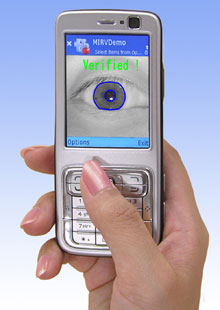
On November 6, Oki Electric announced the development of iris recognition technology for camera-equipped mobile phones. Unlike Oki’s previous iris recognition technology that relies on infrared cameras for the iris scan, the new technology uses ordinary cellphone cameras.

With plans to make the technology commercially available in March 2007, Oki hopes to boost the security of cellphone payment systems.

According to Oki, any camera-equipped cellphone or PDA can perform iris recognition once the special software is installed. Identification accuracy is said to be high, with only 1 in 100,000 scans resulting in error, and the system can tell the difference between flesh-and-blood eyes and photographs.

Source : Pink Tentacle

Tuesday, November 07, 2006

Microsoft Launches Virtual Earth 3D

Microsoft on Monday took the wraps off Virtual Earth 3D, a new version of the company's mapping application that enables users to "fly" through three-dimensional models of cities from directly within their Web browser - complete with virtual billboards.
The idea is that users can type a query into Windows Live Search and click on the "maps" tab to bring up results in a local context, with the ability to view two-dimensional aerial and bird's-eye imagery, or the new 3D models offered by Virtual Earth.
As part of the change, Windows Live Local is being re-branded Windows Live Search Maps.
The service is poised to compete with Google Earth, a standalone application that complements the search giant's online mapping service. But Microsoft says its offering takes the concept to another level, by bringing the virtual world closer to the physical world.
Instead of grey scale boxes of buildings like in Google Earth, Virtual Earth 3D uses photographs to create realistic, textured buildings. Microsoft says it developed the cameras it uses to capture the images in house, as well as creating an algorithmic program to build the textured 3D models.
However, because of the level of detail Virtual Earth 3D offers, Microsoft is launching the product with support for only 15 cities. On the list are San Francisco, Seattle, Boston, Philadelphia, Los Angeles, Las Vegas, Baltimore, Dallas, Fort Worth, Atlanta, Denver, Detroit, San Jose, Phoenix, and Houston.
Not everything will be real, however. Microsoft is putting virtual billboards into the 3D cities it creates, enabling the company to sell advertising directly in these virtual worlds. For example, a billboard advertises Fox above the AMC Lowes cinema in San Francisco. Microsoft was able to accomplish this through technology it acquired from in-game advertising company Massive last April.
Microsoft says it plans to continually add new cities to the service, as well as expanding Virtual Earth to other countries. Developers will also be given access to the APIs in order to integrate the 3D cities into their applications, although this functionality will require a fee.
Virtual Earth 3D only works in Internet Explorer.

Source: betanews

Monday, November 06, 2006

Haptic Research


It is not really sure that there's going to be any consumer haptics devices outside the context of a video game anytime soon, but that hasn't stopped the European Union from funding the HAPTEX (HAPtic sensing of virtual TEXtiles) project. Haptics, of course, is the study of touch sensory feedback, and scientists at the University of Geneva are currently working on a project that will incorporate touch into your online shopping. So let's say that you're looking online to buy pants, but you're not sure if you want corduroys or jeans -- in case you didn't know what those materials felt like, you'd touch a device that would allow you to feel the various textures. The project is due to end exactly one year from now, so that's when we'll find out if the €1.66 million ($2.11 million) that EU taxpayers shelled out was really worth it -- and what devices, if any, will come to fruition.

Friday, November 03, 2006

Sony Ericsson W300i


Over all : A full-fledged music phone for the price of two CDs? Sign us up, especially considering the all-around quality of this attractive flip phone.

Pro: Excellent call quality, reception, battery life, PC connectivity, and music capabilities for the price.

Con: No stereo Bluetooth. Speakerphone should be louder.


Price: $29.99 (with contract) $179.99

Specs:
Service Provider: Cingular Wireless
Screen Size: 1.8 inches
Screen Details: 1.8", 128x160, 262k-color main display; 1", 101x80 monochrome external display
Camera: Yes
Megapixels: 0.3
Bluetooth: Yes
Web Browser: No
Network: GSM
Bands: 850, 900, 1800, 1900
High-Speed Data: GPRS, EDGE
Special Features: Music

Cheoptics360: the future of 3D video is here


Forget what you know about lenticular-based 3D displays, holograms, and even those "real" 3D image projectors being toyed around with in Japan. That 3D image you're looking at above was generated within the Cheotpics360, a four-sided transparent pyramid develop by a Danish team of engineers and designers from viZoo and Romboll. The Cheoptics360 can display both computer and film content when used either indoors or out and scale from 1.5-meters on up to 30-meters. The video images generated by the four projectors are re-assembled within the prism-like pyramid through a process of mirroring and reflection making them appear to float in mid-air. Hear that gamers, how 'bout setting this rig up at your next frag fest! Check the video after the break... you will believe.